

23 July 2026


From Rajasthan’s solar parks and Gujarat’s hybrid projects to Kerala’s floating solar and India’s solar-powered farms, the country’s clean energy journey is being shaped by regional strengths.
India’s renewable energy transition cannot be understood through one national number alone.
It is taking shape across different geographies, technologies and communities: in the deserts of Rajasthan, the salt flats of Gujarat, the Himalayan river systems, Kerala’s backwaters, urban rooftops and agricultural fields.
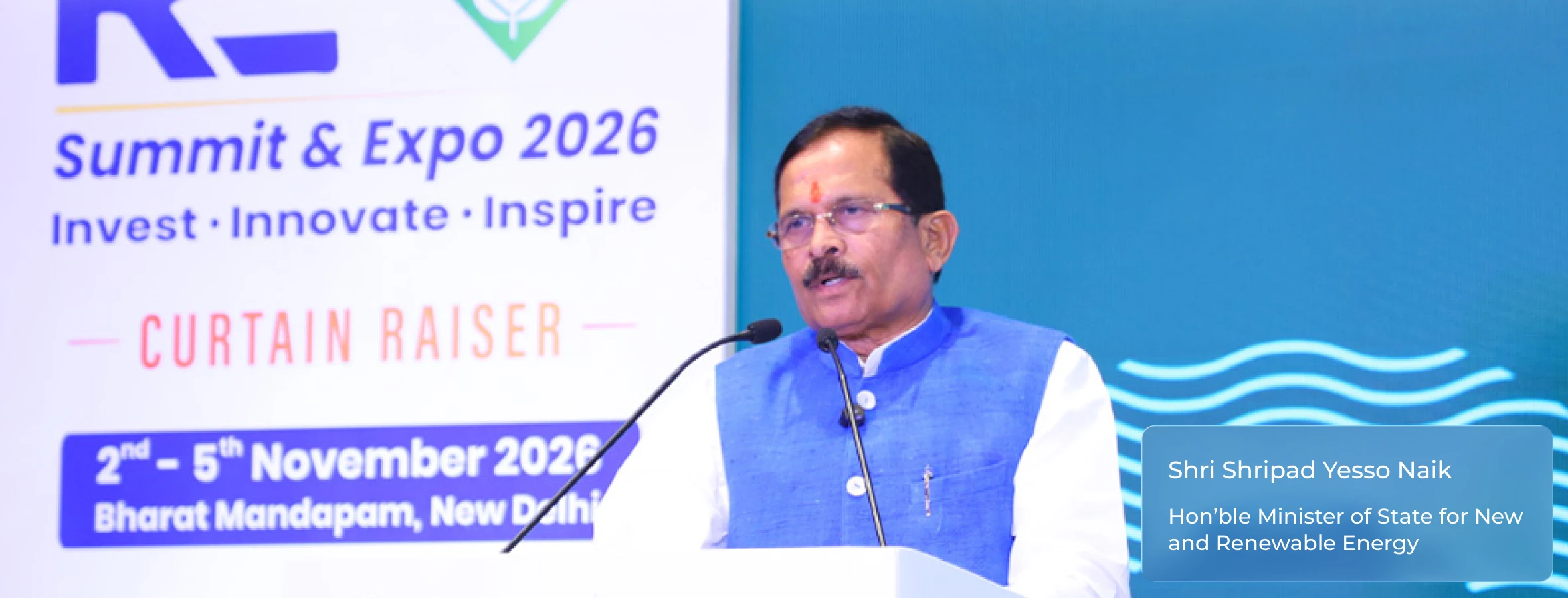
This was the central message of Shri Shripad Yesso Naik, the Hon’ble Minister of State for New and Renewable Energy at the curtain raiser of the Bharat Renewable Energy Summit and Expo 2026, held on 23 July 2026 in New Delhi. India, the address emphasised, does not have one renewable energy landscape. It has many, and that diversity is one of its greatest strengths.
States Creating Scale
Rajasthan has more than 47,700 MW of installed renewable energy capacity and leads India in solar power. The 2,245 MW Bhadla Solar Park has transformed the Thar Desert into one of the world’s most productive clean energy landscapes.
Gujarat has over 49,100 MW of renewable capacity, the highest among Indian states. At Khavda in the Rann of Kutch, a 30 GW hybrid solar and wind park is under development, with the potential to power nearly 18 million homes.
Maharashtra, Tamil Nadu and Karnataka are also driving growth through diversified portfolios spanning solar, wind, biomass and hydropower. At the same time, states such as Andhra Pradesh, Madhya Pradesh and Uttar Pradesh are rapidly expanding the national renewable energy map.
Expanding Beyond Large Projects
India’s transition is not limited to mega parks.
The country has more than 21,000 MW of small hydropower potential, much of it located in remote and border regions. The recently approved Small Hydro Power Development Scheme, with an outlay of approximately ₹2,584 crore, targets around 1,500 MW of new capacity between FY 2026–27 and FY 2030–31.
In Kerala, the floating solar project at Kayamkulam demonstrates how renewable energy can expand without placing additional pressure on scarce land. In Goa, biomass initiatives are converting wood waste into cleaner energy, reflecting the growing role of circular economy solutions.
Taking Clean Energy to People
The transition is also entering homes and farms.
Under PM Surya Ghar, rooftop solar has benefited more than 47 lakh households, with adoption expanding rapidly across Tier-II and Tier-III cities.
PM-KUSUM is enabling farmers to use solar energy for irrigation, reduce dependence on diesel and, in some cases, sell surplus power to the grid. The farmer is therefore moving from being only an anna daata to becoming an urja daata.
This is where renewable energy becomes more than infrastructure. It becomes lower household expenditure, reliable irrigation, additional income and greater energy independence.
A Federal and People-Led Transition
India’s renewable energy journey is fundamentally a federal enterprise.
The Union Government provides policy direction and support, while states drive implementation through local infrastructure, approvals, distribution systems and region-specific solutions.
The transition will also require a skilled workforce. Institutions such as the Skill Council for Green Jobs, national renewable energy institutes and leading IITs are helping prepare engineers, technicians, project managers and specialists for the emerging green economy.
India’s clean energy transformation is therefore not only a technology transition. It is a people’s transition, built through the participation of states, industries, institutions, households and communities.
The Bharat Renewable Energy Summit and Expo 2026 will bring these stakeholders together to accelerate investment, innovation and implementation.
India’s renewable energy strength lies not in one model, but in many models working towards one national ambition.
Follow the Speaker