

23 July 2026


The Joint Secretary outlined how India's renewable energy platform is evolving from a showcase of capacity into a global forum for investment, innovation and implementation.
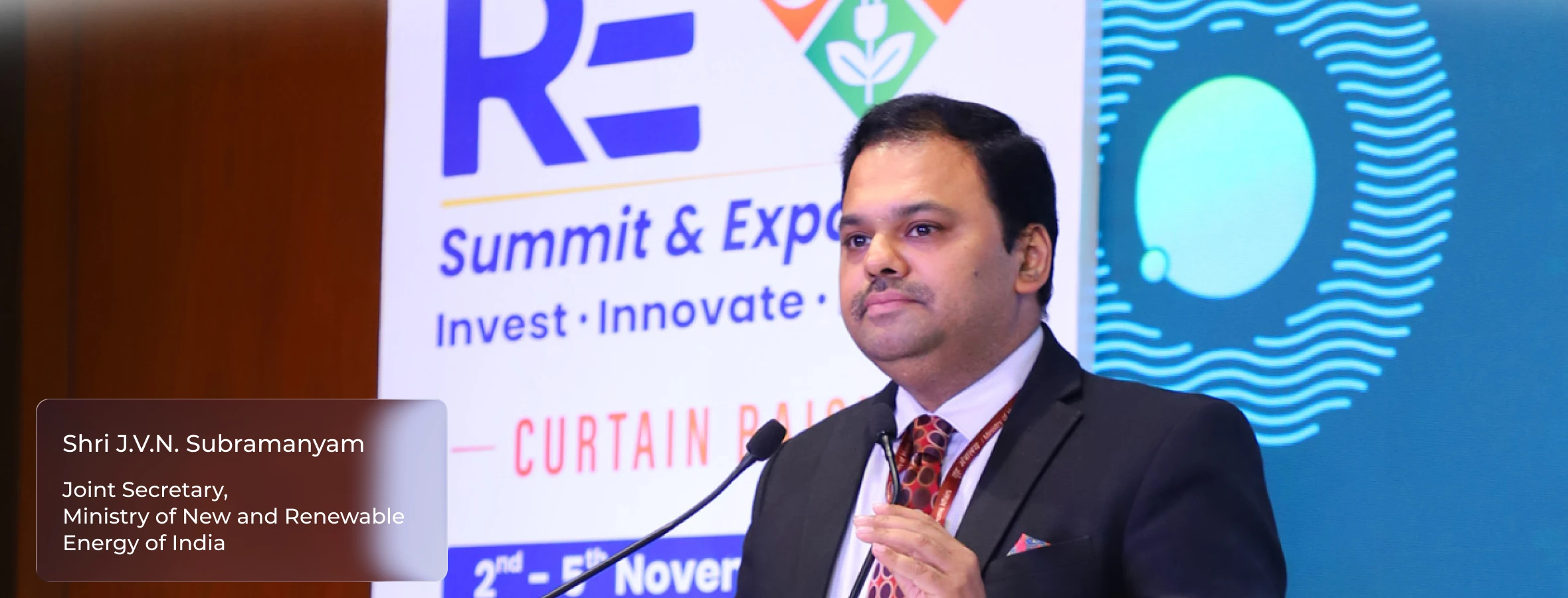
At the curtain raiser of the Bharat Renewable Energy Summit & Expo 2026, the Joint Secretary outlined how India’s renewable energy platform is evolving from a showcase of capacity addition into a global forum for investment, innovation and implementation.
New Delhi, 23 July 2026: India formally began the journey towards the Bharat Renewable Energy Summit & Expo 2026 at a curtain raiser held at The Ashok, New Delhi, bringing together policymakers, diplomats, industry leaders, clean energy institutions and members of the media.
In his address, Shri J.V.N. Subramanyam, Joint Secretary, MNRE, placed India’s energy transition within a larger civilisational context. India’s approach to sustainable development, he noted, is rooted in its long-standing belief in harmony with nature and the principle of Vasudhaiva Kutumbakam—the world as one family. This philosophy continues to shape India’s ambition to build domestically while sharing the benefits of progress globally.
A Platform That Grew with India’s Ambition
The address traced the evolution of RE-INVEST, first convened in 2015 when India’s renewable energy ambitions were still being viewed with caution.
The inaugural edition served as a statement of intent: an invitation to governments, investors, technology leaders and innovators to participate in India’s emerging clean energy journey.
Over successive editions, the platform grew alongside the sector. The most recent RE-INVEST in Gandhinagar attracted more than 25,000 delegates and over 360 companies from across the world.
More importantly, it became a space where policy met technology, ambition met investment and India’s clean energy story connected with the global renewable energy community.
A decade ago, India asked the world to believe in its renewable energy potential. Today, that relationship has changed. The world is no longer merely observing India’s transition; it is participating as a partner, investor and advocate.
Beyond Gigawatts and Capacity Addition
The Joint Secretary emphasised that India’s energy transition can no longer be defined only by solar parks, wind farms, capacity targets and gigawatts.
The next phase will be shaped by an entire clean energy ecosystem: indigenous manufacturing, solar cells and modules, wind turbines, batteries, inverters, green hydrogen, storage, intelligent grids and round-the-clock energy delivery.
It will also require new capabilities in offshore wind, floating solar, agrivoltaics and other emerging technologies. Equally important will be the creation of a skilled workforce capable of designing, manufacturing, deploying and managing clean energy systems at scale.
India is therefore moving from capacity creation to ecosystem creation.
Investment, Innovation and Inspiration
The Joint Secretary identified three drivers that will determine the momentum of India’s energy transition: Investment, Innovation and Inspiration.
Inspiration comes from the national ambition to achieve approximately 500 GW of non-fossil-fuel-based installed capacity by 2030 and around 60 per cent cumulative electric power capacity from non-fossil sources by 2035.
Innovation must come from industry and academia, working together to develop advanced technologies and capabilities.
Investment must be mobilised through domestic, international and multilateral financial institutions, along with dedicated clean energy funds.
The Summit in November will bring these three forces together by creating space for focused conversations, partnerships and commitments.
A New Identity for an Expanded Mission
Beginning this year, RE-INVEST will become the Bharat Renewable Energy Summit & Expo.
The new identity reflects the expanded scope of India’s clean energy mission. The Summit will cover investment and policy, manufacturing and technology, supply chains and skills, while keeping communities and workers at the centre of the transition.
The Bharat RE Summit & Expo 2026 will be held at Bharat Mandapam, New Delhi, from 2 to 5 November 2026. It will be hosted alongside the Ninth Session of the International Solar Alliance Assembly and the Fourth International Conference on Green Hydrogen.
The convergence will bring three major global conversations—renewable energy, solar cooperation and green hydrogen—under one roof.
The Curtain Raiser marked more than the announcement of an event. It signalled the evolution of India’s renewable energy platform—from presenting national ambition to enabling global action.
The Bharat Renewable Energy Summit & Expo 2026 will now seek to connect policy with capital, innovation with scale and clean energy ambition with implementation.
Follow the Speaker