

23 July 2026


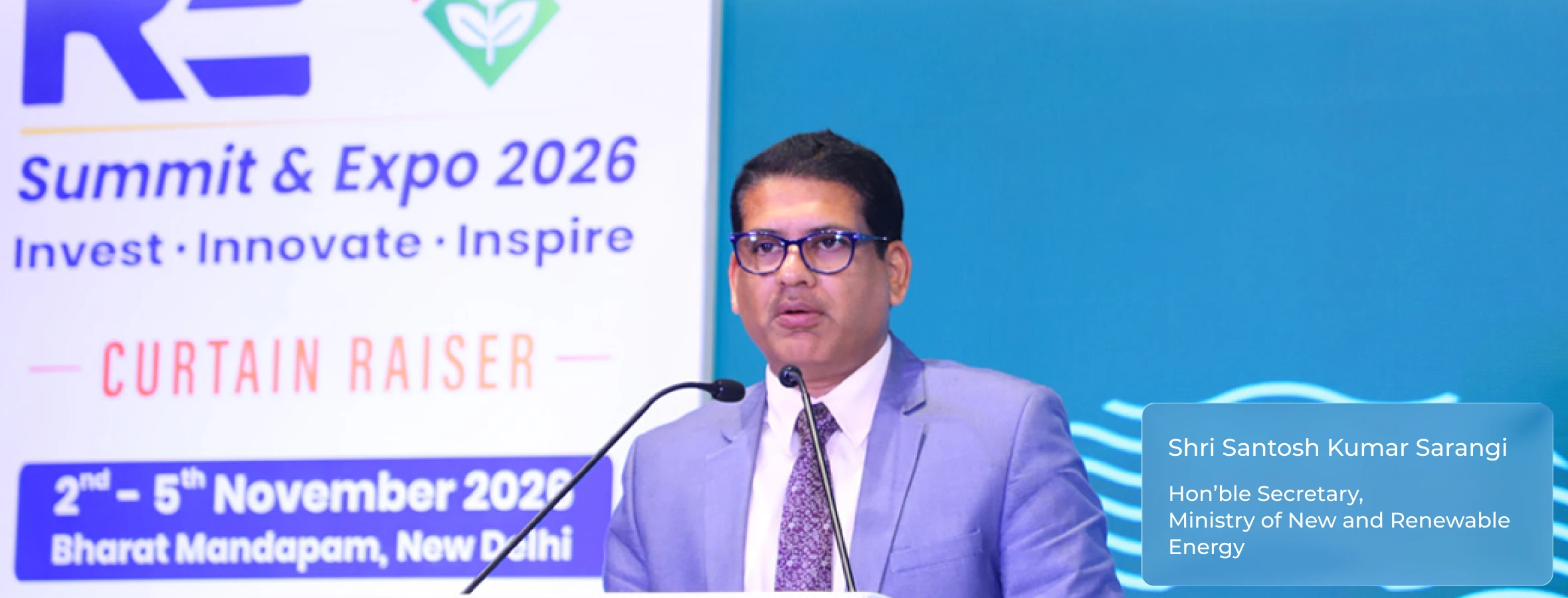
At the curtain raiser of the Bharat Renewable Energy Summit & Expo 2026, the Hon’ble Secretary, Ministry of New and Renewable Energy, outlined the four foundations of India’s renewable energy transformation and the priorities that will shape the decade ahead.
New Delhi, 23 July 2026: India’s renewable energy transformation is not merely a story of rising capacity or falling tariffs. It is the outcome of a policy and market architecture built deliberately over twelve years.
Addressing the curtain raiser of the Bharat Renewable Energy Summit & Expo 2026 at The Ashok, New Delhi, Shri Santosh Kumar Sarangi, the Hon’ble Secretary, Ministry of New and Renewable Energy, highlighted India’s growth from nearly 35 GW of renewable energy capacity in 2014 to close to 290 GW today. During the same period, solar tariffs declined from over ₹10 per unit to approximately ₹2.50, while the sector evolved from a subsidy-led model into one of India’s most competitive and market-driven industries.
The transformation, he underlined, was built on four foundations: policy stability, market creation, ecosystem development and infrastructure.
Four Foundations of Transformation
The first foundation was policy stability. India’s renewable energy targets, supported by instruments such as Renewable Purchase Obligations, created a clear and credible direction for developers, investors and financial institutions. While policies continued to adapt to technology, markets and global supply-chain realities, the long-term ambition remained unchanged.
This consistency has helped attract more than ₹12 lakh crore in cumulative renewable energy investment since 2014.
The second foundation was market creation. India’s shift from administratively determined tariffs to competitive bidding introduced greater discipline, transparency and investor confidence. The sharp decline in solar tariffs was therefore not only a result of cheaper technology, but also of effective market design.
Green open access rules now allow commercial and industrial consumers to procure renewable power directly, while prosumer frameworks enable households and businesses to generate, consume and sell electricity. The government created the architecture; the market began building upon it.
The third foundation was ecosystem development. India’s solar module manufacturing capacity has expanded from approximately 2.3 GW in 2014 to around 192 GW today. Solar cell capacity has grown from nearly 1.2 GW to approximately 30 GW.
Supported by the ₹24,000 crore Production Linked Incentive Scheme, quality-control standards and an expanded Approved List of Models and Manufacturers, India is strengthening the complete solar value chain. The ambition now extends beyond domestic self-reliance towards becoming a global hub for renewable energy manufacturing, project development and exports.
The fourth foundation was infrastructure. Generation capacity matters only when electricity can reach consumers reliably. India is therefore strengthening transmission networks, modernising the grid and scaling battery storage. Approximately $574 billion in investment is planned through 2030 for grid expansion and storage deployment.
From Installed Capacity to System Capability
The central message of the Secretary’s address was that India must now move from installed capacity to system capability.
The first phase of the transition focused on adding gigawatts. The next must ensure that clean power reaches consumers reliably, affordably and around the clock. This will require intelligent grids, storage at scale, expanded transmission and hybrid projects combining solar, wind and storage. Such projects are increasingly becoming part of India’s tendering pipeline, offering more predictable generation and a pathway towards firm, dispatchable renewable power.
The goal is not merely 500 GW of non-fossil-fuel capacity. It is an energy system capable of delivering clean and reliable electricity to every Indian, every hour of the day.
Building the Next Wave
The Secretary also highlighted emerging sectors that could define India’s next clean energy chapter.
Floating solar can expand generation without adding pressure on land. Agrivoltaics can combine farming and power generation on the same land. Offshore wind potential of 37 GW has been identified, particularly across Gujarat and Tamil Nadu.
The National Green Hydrogen Mission, with an outlay of ₹19,744 crore and a target of five million metric tonnes of annual production capacity, is building a new ecosystem for domestic use, manufacturing and exports.
Emerging technologies such as perovskite solar cells and lower-cost storage solutions could further transform the economics of renewable power. These developments will become increasingly important as electricity demand rises across artificial intelligence, data centres, electric mobility, connected technologies and advanced manufacturing.
A Summit for the Decade Ahead
The Bharat Renewable Energy Summit & Expo 2026 will bring together governments, investors, manufacturers, innovators, financial institutions, academia and international partners from 2 to 5 November 2026.
The Summit will also host the Fourth International Conference on Green Hydrogen, creating an integrated platform for conversations around investment, technology, manufacturing, infrastructure and policy.
As the Hon’ble Secretary emphasised, the discussions in November will matter far beyond the event itself. They will help shape the investments, policies and technologies that define the next decade.
The foundations are in place. The next task is clear: convert capacity into capability, innovation into scale and India’s clean energy ambition into a global opportunity.
Follow the Speaker